
Updated
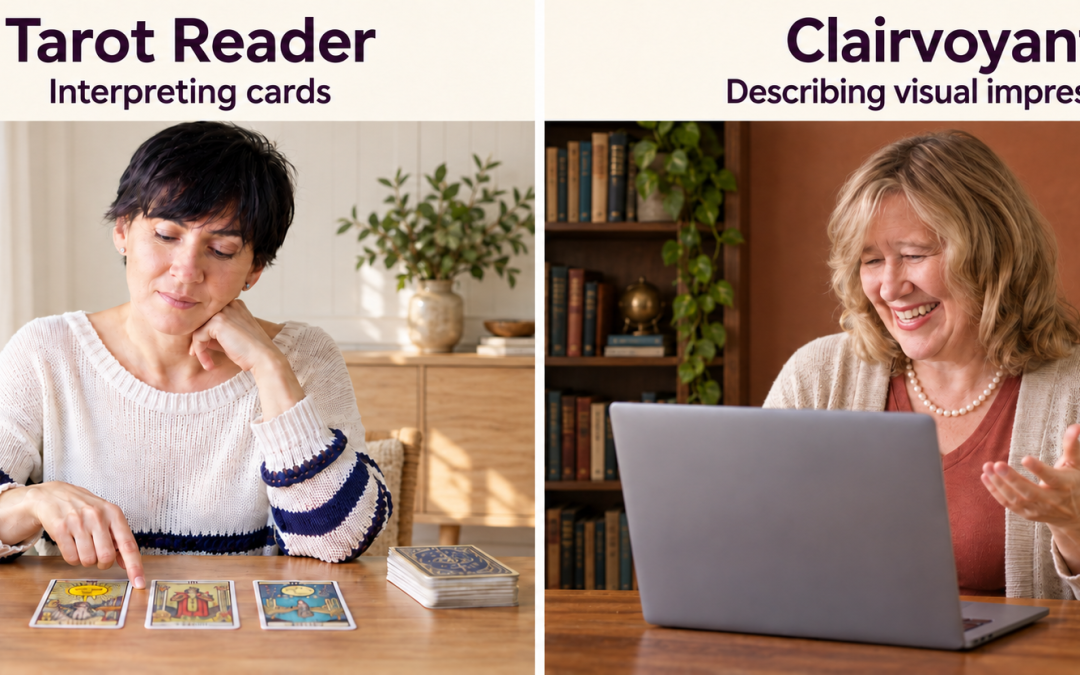
A tarot reader interprets cards; a person offering clairvoyant readings describes impressions they associate with “clear seeing.” Some practitioners combine the two. These labels describe an advertised approach, not a verified level of accuracy or a professional qualification.
If you are choosing a session for reflection or entertainment, compare what actually happens, what it costs and how the reader handles uncertainty. You can also decide that neither format suits your needs.
Compare the experience you are buying
| Question | Tarot reading | Clairvoyant reading |
|---|---|---|
| Starting point | Cards and their interpretation | Impressions described by the reader |
| What you can follow | Ask which cards were drawn and how each meaning was chosen | Ask the reader to distinguish an impression from a factual claim |
| Structure | May use a set spread or an open discussion | May use prepared questions or an open discussion |
| Cost and follow-up | Check the actual rate, duration and terms | Check the actual rate, duration and terms |
The table compares formats without assigning unsupported “excellent” ratings for careers, relationships or prediction. A warm manner, clear explanation or impressive testimonial does not establish access to hidden information.
What a tarot reading can look like
A reader may lay out cards, explain their imagery and connect that interpretation to a question. You can ask to see the cards, hear alternative interpretations and understand whether a suggested action comes from the card, your own circumstances or the reader’s opinion.
For example, if you are considering two jobs, a card could prompt a discussion of what you value. It cannot verify salary, working conditions or an employer’s intentions; check those through the offer, contract and direct questions.
Tarot also has a history beyond divination. The Metropolitan Museum of Art’s account places early tarot in fifteenth-century Italian card games and distinguishes that history from its later fortune-telling associations. The age of a deck tradition does not validate a prediction.
Oracle decks are another card format and should be identified by their own creator and system. Our Get Grounded oracle-card guide shows how a specific card can support an optional reflection exercise.
What a clairvoyant reading can look like
A practitioner may describe mental images, symbols or impressions and invite discussion. Ask how they work, whether they also use cards and whether you can interrupt to clarify something. A conversational format is not automatically more personal, relaxed or reliable.
Keep the distinction between an impression and a fact explicit. “I picture a change around work” is an interpretation. It does not establish that a manager is planning to dismiss you or that a particular vacancy will become available.
Use questions that leave decisions with you
- “Which priorities do I want to compare before making this choice?”
- “What do I need to communicate clearly?”
- “Which part of this situation can I act on?”
- “What information should I check outside this conversation?”
Neither format should be used to diagnose illness, establish someone’s private feelings or replace qualified advice about a consequential legal or financial issue. Changing a question from yes-or-no to open-ended does not make the answer accurate.
Compare costs using the same session length
Do not assume one method costs more or that a higher price indicates better psychic performance. Confirm the currency, billing unit, minimum charge, welcome-offer conditions and any recurring payment. Ask whether clarification after the session is included.
As a hypothetical calculation, a rate of 3 currency units per minute would cost 60 for 20 minutes before any other charges. This is arithmetic, not a quoted provider price. Decide your maximum spend before starting and ask how to end a timed session.
Check profiles and reviews carefully
A profile can describe a reader’s style and experience. A screening claim should explain what was assessed; it is not, by itself, scientific validation. Reviews may help you learn about communication or billing, but a selection of positive stories cannot establish prediction accuracy.
This guide does not rank services or report a controlled accuracy comparison. Treat provider claims as claims to investigate, and read the actual cancellation, privacy and complaint terms before paying.
Keep the option to stop
You may disagree with an interpretation, decline a topic or finish early. Pressure to buy curse removal, promises to make someone return, or demands for escalating payments are reasons to pause and seek independent support. An unsuccessful session does not obligate you to try another reader.
If you simply want time to settle your thoughts, our short beginner meditation guide offers an optional practice without booking a reading.
Frequently asked questions
1. What is the main difference between tarot and clairvoyance?
Tarot uses cards as the starting point for interpretation. A clairvoyant reading is advertised around the reader’s impressions. A practitioner may combine these approaches.
2. Does the word clairvoyant certify an ability?
No. It describes a claimed or advertised approach, not a verified accuracy level or a professional healthcare qualification.
3. Can a clairvoyant also use tarot cards?
Yes. Ask the individual reader which methods they use instead of assuming the categories are exclusive.
4. Is tarot always more structured?
No. A spread can provide structure, but the actual session depends on the reader. Either format may use prepared questions or an open conversation.
5. Is a clairvoyant reading always more personal?
No. Comfort and communication depend on the people and the setting. Feeling understood does not establish that an impression is factually correct.
6. Which format is more accurate?
This guide does not establish that either format reliably predicts events. Clear communication, experience and positive reviews are not substitutes for an accuracy test.
7. Can either reading confirm someone’s feelings for me?
Neither provides reliable access to another person’s private thoughts. Use appropriate direct communication and observable behavior when considering a relationship.
8. Can a reading choose the right job for me?
It may prompt reflection on priorities, but it cannot verify employment conditions or guarantee an outcome. Check the facts of each opportunity and keep the decision yours.
9. Are tarot and oracle cards the same?
They are different card formats. A tarot reader should identify the deck and approach; an oracle deck should be understood through its own creator and system.
10. Does one type of reading cost more?
Do not assume a price difference from the label. Compare the actual rate, billing unit, session length, currency and extra charges.
11. What should I ask about an introductory offer?
Check eligibility, the length of the offer, the price afterward and whether any recurring charge is involved. Read the terms before supplying payment details.
12. Does screening prove a reader has paranormal ability?
No. Find out what the screening actually assesses. A provider’s selection process is not automatically an independent scientific test.
13. Are customer reviews useful?
They can offer information about service experiences such as communication and billing. A few positive accounts do not establish prediction accuracy or guarantee your experience.
14. Can I stop if I feel uncomfortable?
Yes. You can decline topics and end the conversation. Check the billing and cancellation terms in advance, and do not accept pressure to purchase another service.
15. Do I have to try both formats to decide?
No. You can choose one, postpone the decision or book neither. Comparing options should not become a reason to spend beyond your planned limit.