

Tarot reversals are cards that show up in a spread upside down according to the orientation that you choose for the reading. They matter most when the reader has already decided to interpret with that orientation. They don’t automatically mean something that is bad, blocked, or about to happen.
Some readers will use reversals as inward expressions, imbalance, or release, and others read every card upright and find a meaning through the questions and the cards. Both of these are approaches to tarot card practices. Neither of these systems has guarantees of future events.
If you believe that tarot works with intuition, you can pick the right way to help read the cards respectfully. The best question is if reversals add a meaningful difference to your interpretation or if they make the cards confusing.
This guide looks at when being upside down should affect the reading. It offers examples and decision processes. You can start with one method and then change your practice later instead of looking at every reversal as a new spiritual meaning.
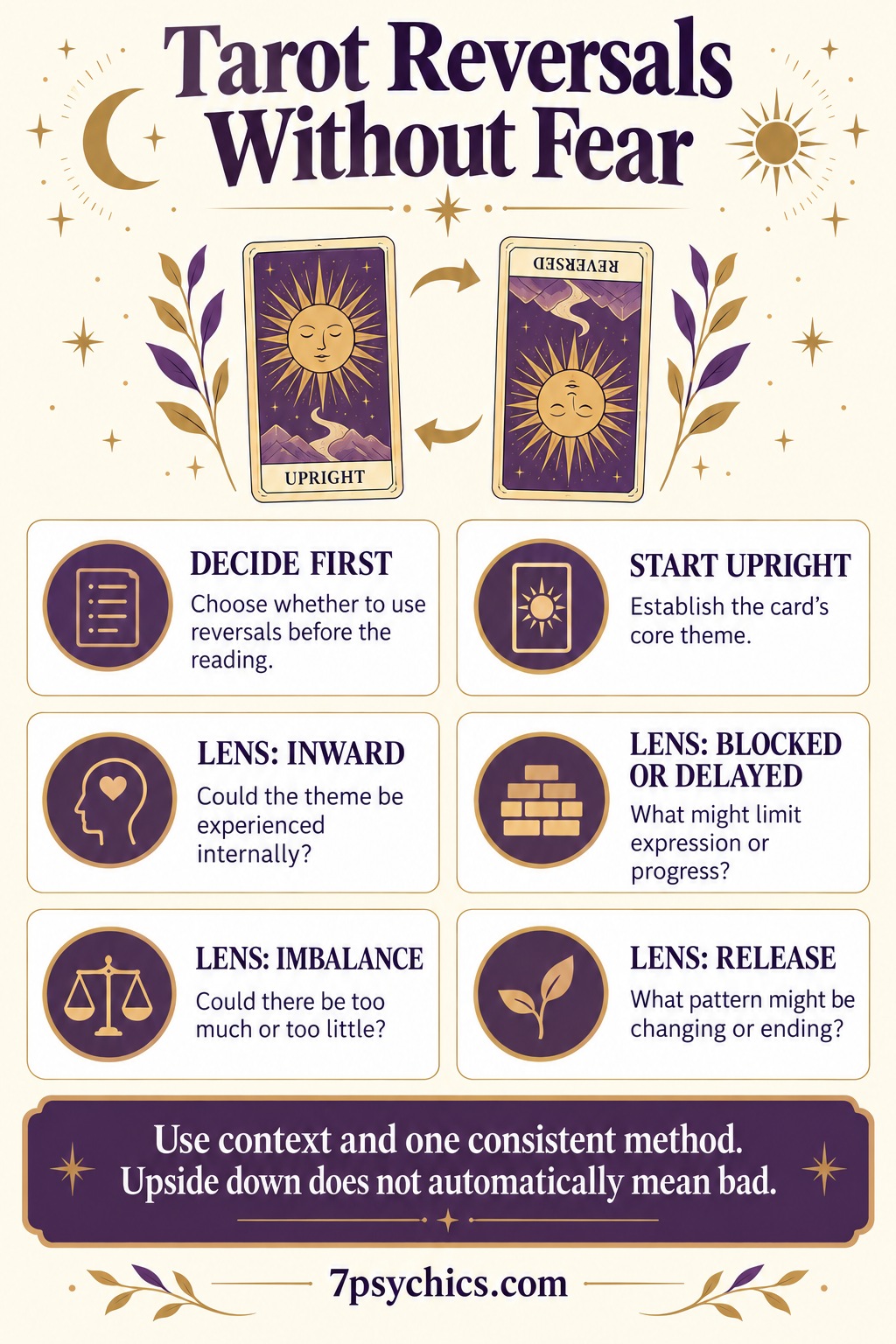
Read the infographic as text
- DECIDE FIRST: Choose whether to use reversals before the reading.
- START UPRIGHT: Establish the card's core theme.
- LENS: INWARD: Could the theme be experienced internally?
- LENS: BLOCKED OR DELAYED: What might limit expression or progress?
- LENS: IMBALANCE: Could there be too much or too little?
- LENS: RELEASE: What pattern might be changing or ending?
Use context and one consistent method. Upside down does not automatically mean bad.
Which Direction is Upright?
If you’re doing your own reading, the card should face you. For a reading across the table, you need to decide if the cards are judged upright from your side or the client’s side. A card can’t be upright for both people if they are sitting opposite of each other.
Start the convention before you draw. Say something like, “I read the orientation from my side of the table.” If you rotate the spread later so the client can see it, keep the original direction in your notes. The act of showing the cards shouldn’t reverse their meaning partway through the session.
Decks that are digital will have their own settings. Some have generated reversals, and others keep all the cards upright. See how the tools work before you agree to the image. A screen that automatically rotates the cards when you turn the device is a display feature and might not be part of the reading method.
Symmetrical card backs can make it harder to see before a draw. An asymmetrical back might reveal this. Either can be used, but you need to be aware of the deck’s design so that you avoid selecting the orientation that you want later.
Deciding About Reversals
Pick the rule about reversals before you shuffle. You might decide to read all the orientations, turn every card upright, or follow the guide. The rule should be the same for the whole reading, so you aren’t changing it to suit your results.
Joan Bunning’s lesson on reversed cards presents one practitioner’s approach and encourages a deliberate choice about using reversals. It is a spiritual interpretation resource. Its claims about energy belong to that framework and should not be treated as scientific explanations of card orientation.
You can try different methods for a short learning period and then figure out which one you like most. Keep the questions low stakes and pick a study approach that doesn’t require you to stay committed later or do a big ritual.
If you decide not to use reversals later, turn the cards upright the whole time. You can still talk about hesitation, excess, or inward feelings when the question and context support these things. These themes don’t disappear just because the image faces a certain direction.
Starting with Upright Meanings
Before you interpret a reversal, talk about the card’s theme in regular language. If you can’t explain the theme, don’t add more layers because it can make the reading harder to follow. Use the imagery of the deck and the guidebook instead of just looking for keywords elsewhere.
The Six of Pentacles might tell you to reflect on giving, receiving, and balance, for example, and a reversal method can then look at how the theme is shown. Starting by saying something is wrong gives less information.
single-card interpretation lesson describes the role of personal response, card meanings, position, and the question. That general practitioner approach is useful for keeping a reversal connected to the actual reading.
Write a base meaning before you add the orientation. Exchange and support, for example, followed by uneven or difficult exchange is easier to understand than listing a lot of reversed keywords. A good foundation allows intuition to be more specific.
Choosing a Method
An inward expression method might use reversals to pay attention to how the card’s theme is experienced privately. It doesn’t show that a person who isn’t there has a hidden feeling. The focus stays on the person who is doing the reading.
If the Queen of Wands shows up reversed in a spread about talking at community events, an inward reflection can be, “I am confident in my ideas but feel worried about showing it in public.” The question is what kind of preparation is needed to make it more comfortable.
This kind of interpretation is different from saying that the card reveals a jealous rival. The same card supports a personal reflection without saying a person is doing something wrong. Court-card meanings are worth handling carefully.
Use the same method consistently. If inward expression doesn’t fit your question, then say that. You don’t have to force a meaning just because there is a reversed card. An interpretation can stay there while still asking good questions.
Picking a Second Method
Another method asks if the card’s theme is hard to access or to express. A reversed card that is associated with collaboration might talk about reflection on roles that are unclear or being afraid to ask for help, but it doesn’t mean that cooperation will always work.
If the Three of Pentacles is reversed in a question about a volunteer project, you might ask if the participants know who is responsible for each of the tasks. The next best step could be having a conversation about roles, seeing if the situation supports the concerns.
Don’t let the word blocked be a diagnosis of spiritual interference. Having a hard time can have regular causes, including missing information, having limited time, or high expectations. A reading can’t show you if someone cursed a project.
This method can help when it leads to a question that you can look at more deeply. It is less useful when each reversal gives a short claim about blockage that only another paid reading can resolve.
Another Method About Imbalance
An imbalance method looks at if the card’s theme is being overused or if it’s being neglected. It needs care because a lot of shortages are opposite possibilities. Pick the direction through the question and the information you know instead of trying to find certainty.
A reversed Emperor in a question about study habits, for example, could tell you to reflect on if the plan is too generic. In another situation, it could tell you to look at if there’s enough structure. Find out which possibilities you are looking at and why these fits.
A good response might be, “Since your question concerns your schedule you can’t keep, look at if the rules are too demanding for you.” This shows a connection. It doesn’t mean that the card works independently of the schedule details.
If none of these things fit, leave the interpretation open. Giving more possible meanings until one fits can be misleading and isn’t accurate. Tarot card reflection can keep a card unresolved.
Release and Changing Patterns
If neither direction fits, leave the interpretation open. Adding more possible meanings until one sounds familiar can create a misleading impression of accuracy. Tarot reflection can tolerate an unresolved card.
If a Ten of Wands card shows up reversed in a reflection about being responsible. You should look at if you’re ready to share a task or to get rid of some of your commitments. That’s a question about your own choices, but it doesn’t guarantee that something will disappear without change.
A reversal card that is about conflict might prompt reflection on how you want to move forward, but it can’t tell you that another person is going to cooperate or that a dangerous situation is becoming safe. The conduct is what is important to look at.
Use the release method as a chosen lens. If you add it with other methods, then explain the reason instead of trying to switch between them if the result doesn’t fit what you want.
Upside Down Cards
Cards can accidentally rotate when they are being dealt, lifted, pictured, or moved across a surface. Decide beforehand how you are going to handle an accident. You might go back to the original orientation if you know it or you follow a consistent rule.
There isn’t a need to look at clumsiness as a warning. If a card turns when someone reaches out for a drink, that is a real explanation. You can look at it without declining spiritual practices.
For cards that fall, pick if they count before you shuffle. A card that slips sideways can create more questions. Some readers include such cards, and others put them back. Consistency matters more than inventing a law about each angle.
If the deck has a card printed incorrectly or if it has a worn edge, that affects how the cards are being handled. Look at it as a tool issue. A repeated reversal can come from the deck. Practical checks and symbolic reflection can work together.
Reversals Don’t Prove Danger
A reversed Lovers card doesn’t mean someone is cheating, and a reversed Death card doesn’t mean death. A reversed Empress doesn’t mean infertility or pregnancy complications. Sensitive claims need evidence and professional care.
If a reader uses a reversal to make an accusation about someone who isn’t there, ask how the claim can be verified. A symbolic interpretation isn’t permission to get someone’s private mind. It shouldn’t be used to override consent or to spy on someone.
If the card makes you feel stressed, talk about the reaction separately from the meaning. If you say that this image worries me, that is a feeling, and if you say that the image proves danger, that is a claim. A pause can help you to see if the interpretation fits with the facts.
You can also decline to use reversals for practice sessions if they add more pressure instead of insight. Make the choice, though, before you draw a card. The reading needs to stay voluntary and honest.
Comparison of Cards
Pick one card and a question such as improving a study routine. Write an upright interpretation and then add one reversal method and write if anything changes. Keep the version clear in a few sentences.
The Four of Swords card, for example, in the upright position, might mean rest or pause, and under an imbalanced method, this reversal could tell you to ask if you’re returning to work too fast or if you are being withdrawn more than you should be. Pick the direction using your situation and then explain it.
Now ask if the reversed version is a useful distinction for you. If it just repeats the upright idea in different language, make the method easier. If it clarifies a question, you can look at it, keep going.
This is a learning exercise and isn’t a test of accuracy. You can look at clarity, relevance, and consistency without needing to confirm dramatic events with the cards.
Questions for Reversals
A good question gives you information without the card being in control. You might say, “What should I reflect on about getting help?” This can make a reversal about receiving to be meaningful for you. Asking, “Will someone betray me secretly?” gives an accusation that can cause you to worry.
Joan Bunning’s question-writing lesson offers a practitioner perspective on retaining responsibility for decisions. You can adapt that principle by asking about your choices and the information you still need.
If you’re doing dream interpretation, a reversal can have you explore an image from a different point of view. Maybe a dream of missing a train has you asking questions about ignoring an opportunity. Keep the thoughts personal instead of claiming that the card makes the dream a prophecy.
This question should cause you to take action or to reflect on real-life experiences. If the answer would mean ignoring medical concerns or crossing someone’s personal boundary, the reading is no longer useful.
Final Thoughts: Being Consistent
Write down the method, question, card, and the interpretation. Pay attention if an interpretation didn’t fit. A complete journal gives you a better look at your practice instead of just examples that stand out.
Review if you changed methods after the outcome happened. If a reversal meant a delay before an event happened, then write down the change honestly. You can learn from something new without trying to change the original reading.
You might decide to combine methods together. If you do, explain how you pick amongst them and avoid looking at every possible meaning all at one time. A good reader can talk about uncertainty without making the interpretations useless.
Upside down matters when it adds a layer to the reading. Pick your own rules, start with the card’s theme, and then use the method that works with the question. Reversals can help support intuitive reflection but allow your decisions to be made with your own judgements.