

Updated
A singer’s voice can make a difficult evening feel less lonely. An actor’s account of starting over may seem to describe your own life. After months of following someone, you might call that familiarity an “energetic connection.” The feeling matters to you, but it does not establish that the celebrity knows you, feels the same bond or sends you private messages through public content.
Psychology offers a useful term: a parasocial relationship, an emotional attachment that is largely one-sided. Understanding that distinction lets you enjoy the music, stories and community while keeping your own choices, money and relationships in view.
What a parasocial bond can—and cannot—tell you
You may know a performer’s interviews, stage habits and public milestones very well. That is knowledge of material they have shared, sometimes shaped by a production or publicity team. A person who knows you in return can ask about your situation, hear your answer and change how they respond. Watching a familiar person on a screen does not create that exchange.
A personal reply or a brief meeting is real contact. It still has its own scale: one interaction does not establish a close friendship, a romantic relationship or ongoing access. You can appreciate the moment without having to make it mean more.
Keep these three experiences separate
1. Emotional resonance
“This song expresses something I have struggled to say.” That describes your response to the work. It does not reveal what its creator privately feels about you.
2. Friendship within a fandom
“Another fan checked in after our conversation.” That can be a mutual connection with the other fan, developed through actual contact and respect.
3. A relationship with the public figure
“We know each other and communicate directly.” This requires evidence of an actual relationship. Familiarity with someone’s posts cannot supply it by itself.
Why public content can feel so personal
Regular exposure gives you a familiar voice, a predictable routine and stories you recognize. A creator speaking into a camera may address an entire audience with “you,” while each viewer experiences the message alone. A performance can also become attached to a particular memory: a journey, a loss, a friendship or a period when you needed encouragement.
There is also a difference between recognizing a value and knowing a person completely. You might admire an athlete’s persistence or a musician’s openness about a struggle. Their public example can help you name a quality you want to practise. It does not require a conclusion that your lives are linked by destiny.
Cleveland Clinic’s explanation of parasocial relationships describes how repeated exposure can encourage a sense of intimacy. It also distinguishes ordinary enjoyment from situations in which the attachment interferes with everyday life. The useful question is what the bond is doing in your life, rather than whether you are a “real fan.”
What research actually measured
In a 2024 Scientific Reports study by Shaaba Lotun and colleagues, three studies involved 3,085 participants in total. In the first two, people rated a strong parasocial bond as more able to meet emotional needs than an acquaintance, but less able than someone close to them.
Those were participants’ ratings of perceived support. They were not measurements of a celebrity returning a feeling, psychic communication or fans’ brain activity. The authors also identify a need to test actual emotional outcomes when people use different sources of support. The findings help explain why a bond can feel valuable; they do not prove that it replaces mutual care.
What does “energetically connected” mean here?
You may use “energy” as a metaphor for warmth, excitement, recognition or calm. You may also give the experience a spiritual meaning. You can reflect on that meaning without treating it as independently verified information about another person.
For example, a tight chest while watching an emotional interview tells you that you are noticing a bodily sensation. Tears during a song tell you that it moved you. Neither sensation, by itself, tells you the performer’s present mood, intentions or private circumstances. A vivid dream, repeated lyric or coincidental posting time also does not establish a message intended specifically for you.
Thinking often about a celebrity, reacting to their public story and feeling understood by their work can all describe emotional involvement. They are not a test for a mutual energetic bond. A list of feelings cannot measure brain activity or establish which brain systems are active in a particular person.
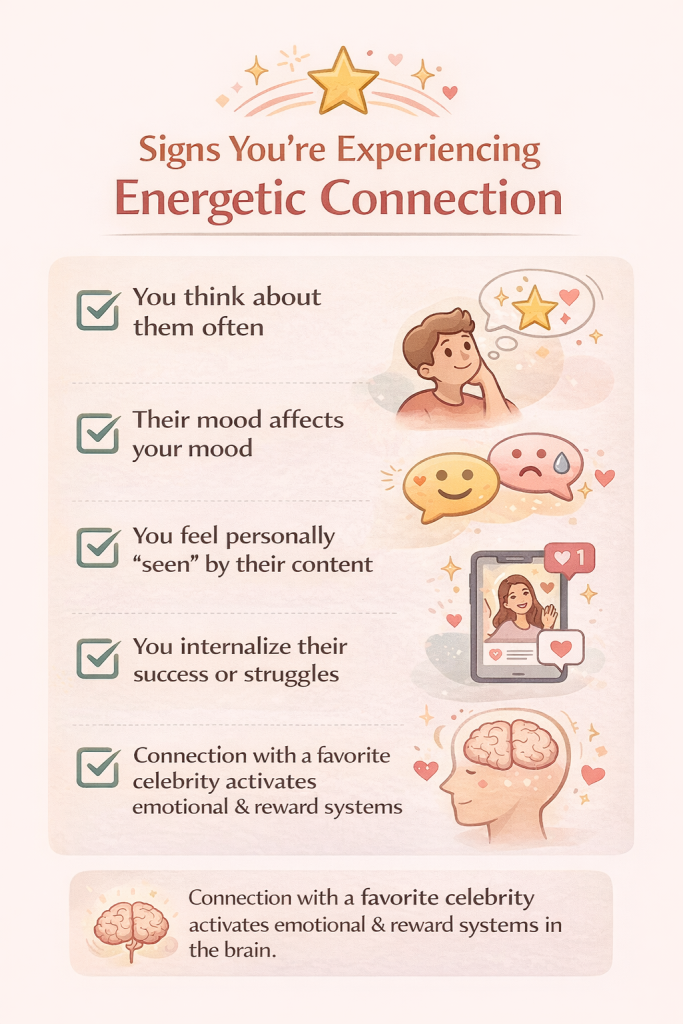
Use these experiences as reflection prompts, rather than proof of access to someone else. Ask what you noticed, what it brought up in your own life and which part you can actually verify.
A three-line note for a strong reaction
- What happened publicly? Write the observable event: “I watched an interview about moving away from home.”
- What happened for me? Name your response: “I felt sad and remembered my own move.” Keep this separate from a claim about the celebrity’s private feelings.
- What would help in my own life? Choose an action you control: call a friend, make time for music or write about the memory. You do not need the celebrity to acknowledge you for that action to matter.
This is a reflection exercise, not a diagnostic score or a way to calculate how connected two people are.
Enjoy fandom without making it an obligation
There is room for enthusiasm: sharing a favourite performance, creating fan art, discussing a character or meeting people with a similar interest. You do not have to reduce a meaningful experience to “just content.” You also do not have to prove loyalty through constant attention or purchases.
Set boundaries around the parts that have a practical cost. Choose when to look at updates, what you can afford and which information you will leave private. A ticket, membership, donation or merchandise purchase buys what its terms describe; it does not buy personal closeness. Paying more does not make your feelings more legitimate.
An example: keep the song, change the routine
Imagine Dana, who finds comfort in a performer’s music after moving to a new city. She starts checking fan updates late at night and notices that she is tired at work. Instead of deciding she must abandon the music or buy every release to stay connected, she turns off update alerts after dinner, saves one listening session for the weekend and arranges a call with a friend.
The next question is concrete: is she sleeping better and following the plan she chose? This example offers a way to change a routine. It does not predict an outcome or diagnose Dana.
Four boundaries you can choose today
- Protect a period of time. Pick an activity you want to keep free of updates, such as sleep, work or a meal with someone. Mute notifications or move the app if that helps you keep the boundary.
- Decide the full spending limit before browsing. Include tickets, travel, subscriptions and merchandise as applicable. Check recurring charges and refund terms. Leave the purchase if it would take money needed for essentials.
- Keep privacy and consent intact. Use public events and official contact channels. Do not search for private addresses, pursue uninvited contact or treat public posts as permission to enter someone’s personal life.
- Make room for a mutual conversation. Reach out to someone who can respond to you as a person, or try a shared activity where a connection can develop gradually. Fan friendships count when the care and communication go both ways.
If it helps to pause before checking another update, our beginner meditation guide offers a brief, optional practice. You can also simply put the phone down and notice your surroundings. A pause is useful only if it helps you choose your next action; it is not a way to receive a celebrity’s thoughts.
When the attachment needs more support
Pay attention to specific changes: repeatedly losing sleep, missing responsibilities, spending money you need elsewhere or withdrawing from people you care about. Distress about an unanswered message or a celebrity’s relationship can also be worth discussing. You do not have to wait until a problem becomes extreme to ask for support.
If you feel certain that ordinary broadcasts contain private instructions for you, or you feel compelled to act on a supposed message, pause before acting and talk with a qualified mental-health professional. A therapist can help you examine the experience and its effects without needing to confirm a secret connection. Our guide to choosing between a therapist and a psychic explains the different roles.
A strong feeling is something you can take seriously as part of your own experience. The next step is to understand what you need and what you can verify, while respecting both your life and the public figure’s boundaries.
Frequently asked questions
1. Is feeling close to a celebrity automatically unhealthy?
No. Enjoying someone’s work or feeling comforted by it does not by itself show a problem. Look at its effects on sleep, responsibilities, spending, privacy and your ability to maintain mutual relationships.
2. Does a strong feeling mean the celebrity feels connected to me too?
The intensity of your response does not establish reciprocity. Public content, dreams, coincidences and bodily sensations cannot show another person’s private feelings toward you. An actual relationship requires direct, appropriate communication and mutual knowledge.
3. Can a celebrity’s work still help me if the bond is one-sided?
Yes, you may find comfort, ideas or encouragement in the work. That value can exist without a personal relationship. Keep other sources of support available, especially people who can hear and respond to your particular situation.
4. What if a celebrity replies to my comment?
A reply is a real interaction, but its meaning depends on what was actually said and the context. A brief acknowledgement does not automatically create friendship, romantic interest or permission for further private contact.
5. Should I stop following them completely?
You can choose a smaller change first if that fits your situation, such as muting alerts or setting a spending limit. If engagement keeps causing distress or interfering with daily life, take a break and seek support. There is no obligation to stay involved to prove loyalty.
6. What should I do if public posts feel like private messages to me?
Do not act on an assumed instruction or pursue uninvited contact. Pause, check the context with someone you trust and talk with a qualified mental-health professional if the certainty or distress persists. Feeling addressed by content is not proof that it was created specifically for you.