
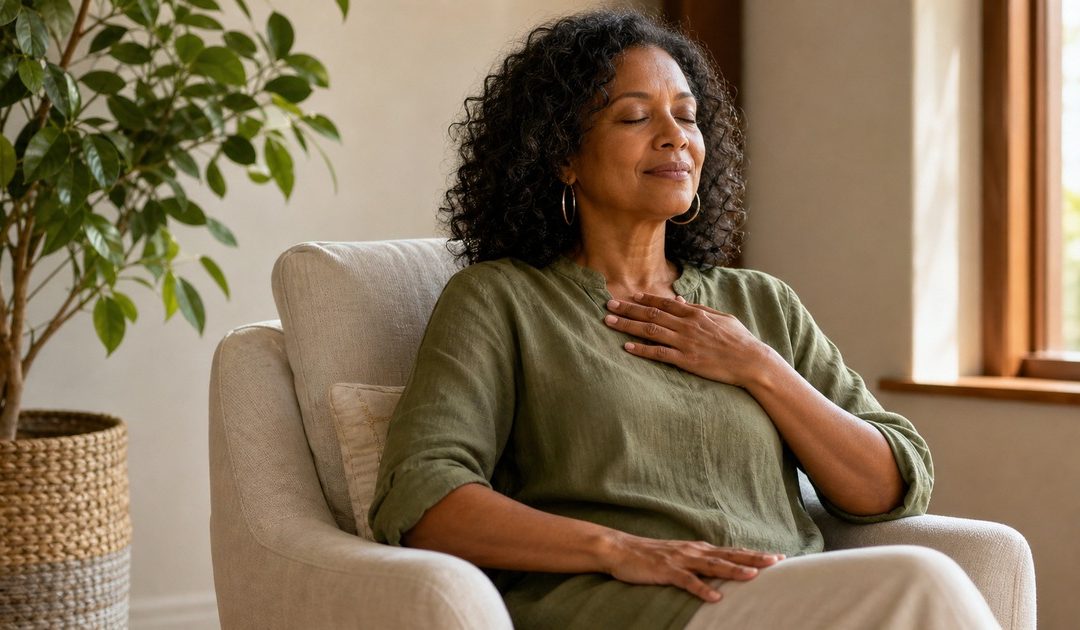
Your hands can provide warmth, pressure, attention, and a familiar cue to pause. Those effects can feel spiritually meaningful, but they are not proof that palms transmit a medically healing energy field.
Quick Guide
- Use gentle, comfortable touch; pain, dizziness, numbness, or distress means stop.
- Treat warmth and tingling as ordinary sensations unless you personally choose a spiritual interpretation.
- Use palm rituals for brief self-soothing—not to diagnose, cure, or delay medical or mental-health care.
- Pair the ritual with one practical next step, such as water, rest, a boundary, or professional help.
Pause
Choose a safe position and notice what is happening now.
Place
Rest a hand gently where touch feels comfortable and welcome.
Breathe
Let the exhale lengthen without straining or holding your breath.
Proceed
Reassess, then take the smallest useful real-world action.
What a Palm Ritual Can Realistically Do
A hand over the chest, palms pressed together, or fingers wrapped around a warm mug can narrow attention to a simple physical sensation. That pause may help some people feel comforted, less scattered, or more aware of tension. A 2026 randomized trial found that a brief self-soothing-touch practice reduced momentary stress, fatigue, and loneliness, with results comparable to the study’s brief meditation condition. The sample was small and young, and longer-term questionnaire effects were not established, so this is promising evidence for a short calming practice—not proof of healing disease.
Spiritual traditions may describe palm warmth as chi, prana, Reiki, or energy. People are free to use that language for personal meaning. The U.S. National Center for Complementary and Integrative Health, however, says Reiki has not been clearly shown effective for a health-related purpose and that there is no scientific evidence for the proposed energy field. Keep the meaning; lose the medical certainty.
Seven Hands-On Calming Rituals
1. Hand-to-heart pause
Place one hand on the upper chest if touch there feels safe. Name the emotion in one or two words, then take three easy breaths. The goal is not to force calm; it is to notice your state before choosing what comes next.
2. Palm warming
Rub your hands for five to ten seconds, then hold them apart. Warmth, tingling, or pulsing usually reflects friction, temperature receptors, circulation, muscle activity, and focused attention. You can imagine light between your palms as a visualization without calling the sensation scientific proof of aura energy.
3. Five-finger tracing
Trace slowly up and down each finger with the opposite index finger. Let an inhale accompany the upward movement and an unforced exhale accompany the downward movement. If breath counting makes you tense, simply track the movement.
4. Pressure and release
Press the palms together at a comfortable intensity for three seconds, then release. Repeat three times while noticing the contrast. Avoid this if you have hand pain, recent surgery, inflammation, or an injury.
5. Warm-mug grounding
Hold a comfortably warm—not hot—cup with both hands. Notice temperature, weight, texture, and scent. This is a discreet sensory anchor at a desk or during a difficult conversation.
6. Gratitude at the palms
Bring palms together and name one specific support available today: a person, place, skill, meal, appointment, or boundary. Gratitude is not a demand to ignore pain; it is a brief widening of attention.
7. End-of-interaction reset
After a stressful call, brush the palms lightly, wash your hands, or rest them on a table while saying, “That interaction is over; I choose my next step.” The gesture can mark a boundary without claiming another person’s energy literally attached to you.
Turn Sensation Into Useful Information
| You notice | Grounded interpretation | Possible next step |
|---|---|---|
| Warm palms | Friction, circulation, temperature, attention | Continue gently if comfortable |
| Fast heartbeat | Stress, exertion, caffeine, illness, or other causes | Pause; seek care for concerning symptoms |
| Emotional heaviness | A feeling that deserves naming, not a diagnosis | Journal, talk, rest, or get support |
| Numbness or pain | A physical symptom—not an energy blockage | Stop and consult a qualified clinician if persistent |
For a broader routine, combine these practices with the site’s eight-step mindfulness guide. The article on restoring calm while separating spiritual language from medical claims uses the same grounded distinction.
When Touch Is Not Calming
Self-touch can feel uncomfortable after trauma, during panic, with sensory sensitivity, or because of culture and personal preference. Use sight, sound, movement, or contact with a neutral object instead. Never place pressure on an injury, burn, rash, surgical site, chest pain, or unexplained swelling. Sudden weakness, severe pain, trouble breathing, or other urgent symptoms need medical attention—not an energy ritual.
A Two-Minute Routine
- Orient to the room and put both feet somewhere supported.
- Choose one comfortable hand position.
- Notice three sensations without interpreting them.
- Take three natural breaths, allowing a slightly slower exhale.
- Name one need and one realistic action.
Repeat only when it remains helpful. The point is not to perform the perfect ritual; it is to return to choice.
Key Takeaways
- Gentle self-touch may provide a brief, accessible calming cue for some people.
- Warmth or tingling in the palms is not evidence of a scientifically verified healing field.
- Consent, comfort, symptom awareness, and practical follow-through keep the ritual safe.
- Spiritual meaning can coexist with clear limits and appropriate professional care.
Frequently Asked Questions
1. Do palms emit healing energy?
Spiritual traditions may interpret palms that way, but science has not established a medically healing energy field emitted by the hands.
2. Why do my palms tingle after rubbing them?
Friction, warmth, pressure, circulation, muscle activity, and focused attention can all create tingling or pulsing sensations.
3. Can a hand-to-heart practice reduce stress?
It may provide momentary comfort for some people. Evidence on self-soothing touch is emerging, but it is not a cure for anxiety or another condition.
4. Is this the same as Reiki?
No. These are self-soothing and mindfulness exercises. Reiki is a distinct complementary practice based on a proposed energy field.
5. Can I use palm rituals during a panic attack?
Only if touch and breath focus feel safe. If symptoms intensify, orient to external sights and sounds and seek appropriate help.
6. How long should a palm ritual last?
Thirty seconds to two minutes is enough for a check-in. Longer is not automatically better.
7. Can I perform these practices in public?
Yes. Holding a mug, pressing fingertips together, or resting hands on a table can be discreet.
8. Should I close my eyes?
Not necessarily. Keep them open if closing them feels unsafe, dizzying, or dissociating.
9. Can palm rituals treat pain?
They may be comforting, but they do not diagnose or treat the cause of pain. Persistent, severe, or new pain needs clinical assessment.
10. What if my hands are injured?
Avoid pressure or friction and use a non-hand-based grounding cue. Follow your clinician’s guidance.
11. Can I touch another person to calm them?
Only with clear consent and appropriate boundaries. Do not claim that touch will heal them.
12. Do I need crystals or incense?
No. The practice relies on attention and a safe sensory cue; no object is required.
13. What should I do after the ritual?
Choose a concrete next step such as drinking water, taking a break, setting a boundary, or contacting support.
14. Can children use these rituals?
Simple, non-forced versions may be used with caregiver guidance, but respect the child’s consent and stop if uncomfortable.
15. When should I seek professional help?
Seek help when distress is persistent, worsening, impairs daily life, or includes urgent physical or safety symptoms.